
Criminal Cases in Toombs County Courts
Toombs County Superior Court hears felonies, grand-jury indictments, and petitions or appeals tied to record restriction. The Clerk of Superior Court keeps those criminal case files at 100 Courthouse Square in Lyons. State Court handles misdemeanors and traffic within its legal reach. Magistrate Court receives warrant applications and conducts first appearances or other preliminary work. Vidalia and Lyons municipal courts retain qualifying city ordinance and traffic matters.
That split makes the charging paper more useful than a broad name search. A city citation may never become a Toombs County Superior Court case. A felony arrest, by contrast, may begin in Magistrate Court and later produce an indictment in Superior Court. The sheriff owns the booking file, but the clerk owns the filed prosecution and final court result.
Choose the Right Toombs Court
The court allocation is a quick way to avoid a false “no record” result. Start with the charge level and issuing agency, then confirm the venue on the citation or charging instrument.
| Court | Criminal role | Contact |
|---|---|---|
| Superior Court | Felonies, indictments, restriction petitions | 912-526-3501 |
| State Court | Misdemeanors and traffic | 912-526-3803 |
| Magistrate Court | Warrant applications and preliminary matters | 912-526-8984 |
| Lyons Municipal Court | City ordinances and misdemeanor traffic | 912-526-3638 |
Vidalia court matters require city routing. If the court is still unclear, the Georgia Find a Court directory can identify an official office before a records request is sent.
How to Search Case Records
The Georgia E-Access to Court Records directory routes users to participating vendors. It is not a single free database, and Toombs Superior Court is not clearly shown in its provider table. An account may be required. A missing vendor result is therefore not proof that no Toombs County criminal case exists.
- Read the citation, accusation, indictment, or hearing notice and identify the court.
- Try the official provider directory with the name or case number available.
- Call the correct Toombs County clerk with the name, case number, and approximate date.
- Ask for the docket, document index, and final disposition, not merely a verbal status.
- Specify a plain or certified copy and ask staff to quote current cost and delivery choices.
| Search detail | Format | Best use | Limit |
|---|---|---|---|
| Party name | First and last name | Find candidate files | Common names need more detail |
| Case number | Court-assigned text | Exact file match | Must match the court |
| Approximate date | Filing or arrest range | Helps clerk retrieval | Not a unique key |
| Case type | Felony, misdemeanor, traffic | Selects the proper court | Charges may change |
Georgia E-Access and Toombs Gaps
The official directory’s limits matter in Toombs County because no verified free, comprehensive local criminal docket was found. The courthouse remains the authoritative fallback. Older or nonelectronic files may need staff retrieval, and exact public-terminal access, provider coverage, copy fees, and courthouse device rules were not published in enough detail to state as fact.
The county Clerk of Court page identifies the office, while the clerk’s own gateway supports court-record and eCertification access. This county source image shows the Clerk page that routes record seekers.
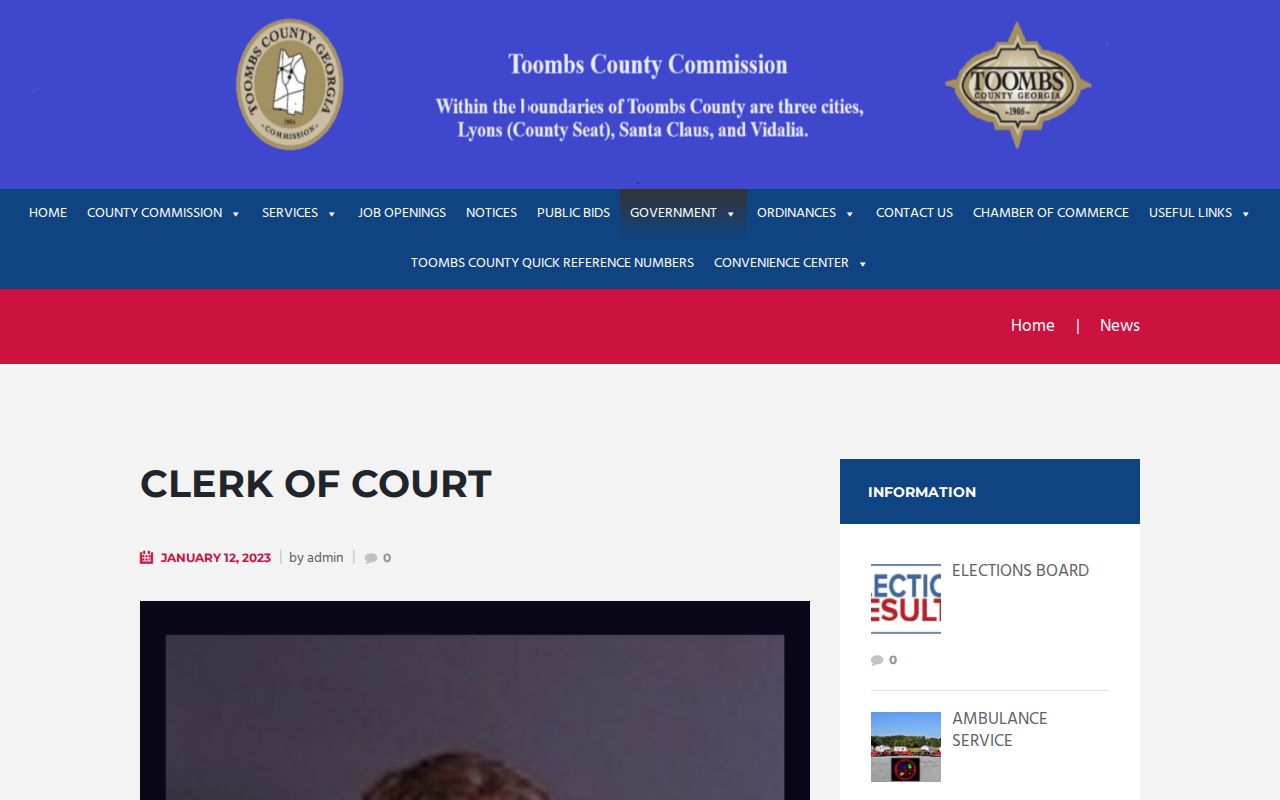
Use the office number before travel to confirm hours, the correct counter, payment methods, and whether the requested Toombs County case can be delivered remotely.
The state directory itself is shown in this official E-Access source image.
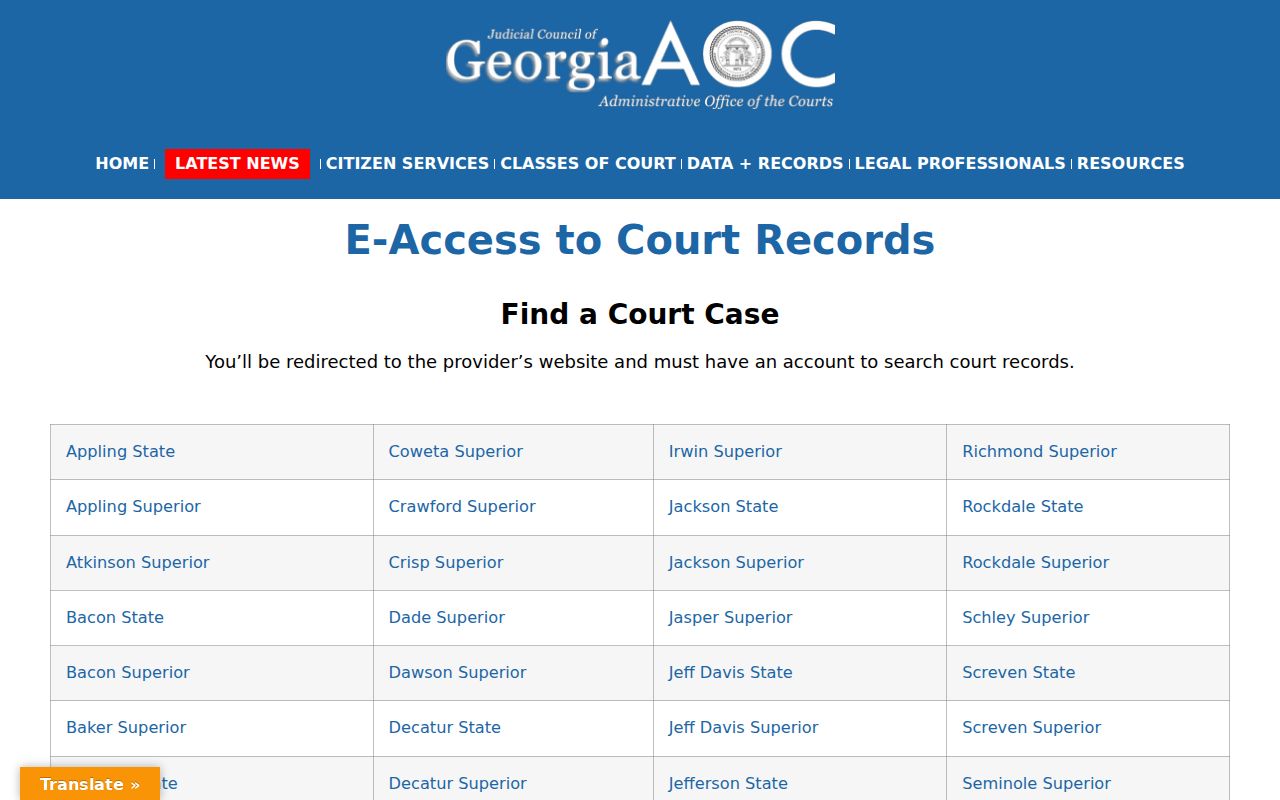
Its role is routing, not certifying that every Toombs case is indexed.
What the Case File Shows
A Toombs County criminal case file records the prosecution after charges are filed. The exact public view can vary, but the clerk file may include the charging document, hearings, motions, pleas, court orders, judgment, and sentence. It answers a different question from the arrest report or current jail profile.
| Case number and court | Identifies the file and the custodian. |
|---|---|
| Charging document | Shows an accusation, indictment, or other filed charge. |
| Docket entries | Lists events and filed documents in time order. |
| Hearings and pleas | Shows scheduled proceedings and formal answers. |
| Disposition and judgment | States the outcome for each filed charge. |
| Sentence and conditions | Records custody, probation, fines, costs, or restitution when imposed. |
Bond may appear, but it is security for release and appearance, not a fine or a finding of guilt. A certified disposition is usually the best court proof when another system shows an old or unresolved charge.
Read Toombs Disposition Terms
Georgia docket terms can change the meaning of a case. “Nolle prosequi” means the prosecutor chose not to continue a charge. A no-bill means the grand jury did not return an indictment. A dead docket pauses a case for an indefinite period and does not automatically equal dismissal.
- Accusation
- A prosecutor’s formal charging document.
- Indictment
- A grand-jury felony charging instrument.
- Disposition
- The final outcome recorded for a charge.
- True bill
- A grand jury returns an indictment.
- Arraignment
- The hearing at which a plea is entered.
Read each charge row, not only the overall case status. One count can end differently from another. Ask the clerk to explain how to obtain the underlying order rather than guessing from an abbreviated docket label.
Stages of a Criminal Case
A Toombs County case can change from the offense listed at booking. The prosecutor may file a different charge, a grand jury may return or decline an indictment, and the court may resolve separate counts in different ways. The court file, not the first booking label, tracks those steps.
Case flow: Charges Filed › Arraignment › Pretrial › Plea or Trial › Disposition › Sentencing
Magistrate warrant applications sit before or beside that main path. The Toombs Magistrate Court criminal page describes the local application process.
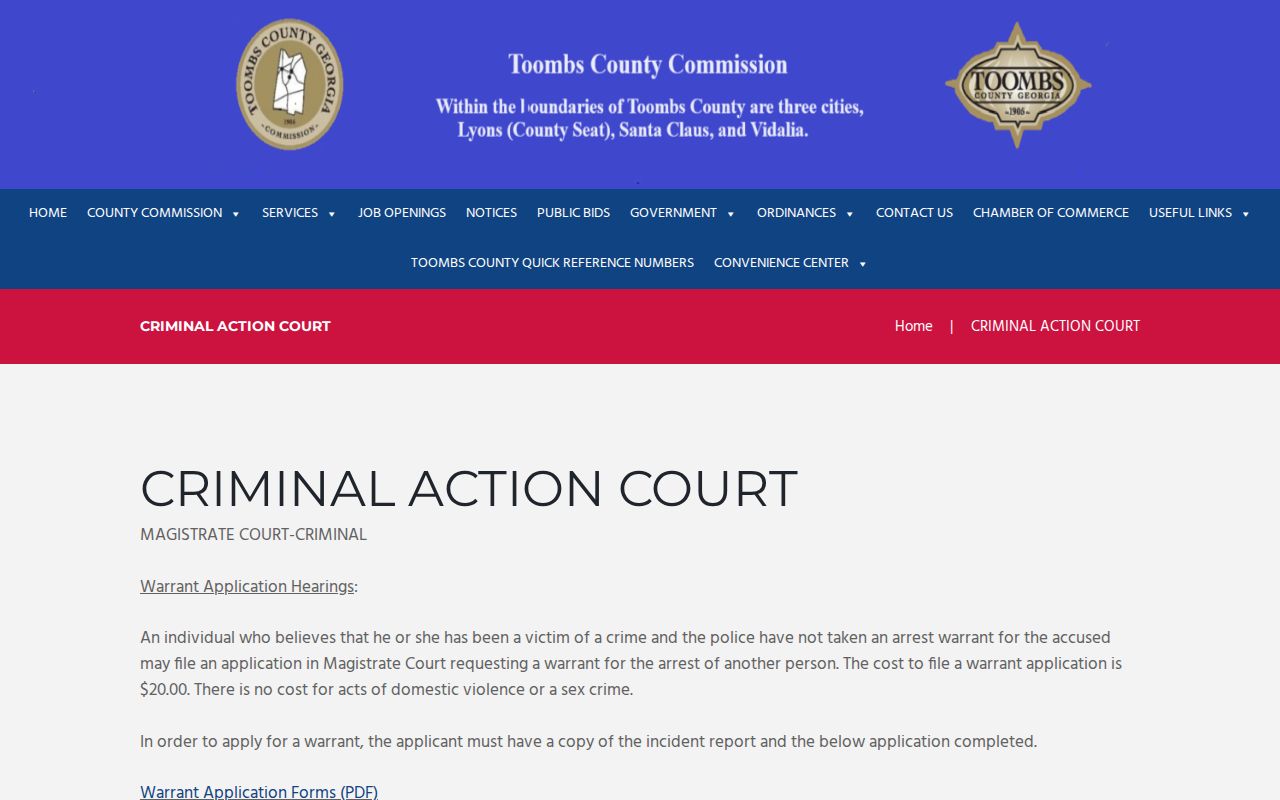
An application is an allegation submitted for judicial review. It is not a conviction, and it may not become a filed Superior or State Court prosecution.
Middle Circuit, Not Toombs Circuit
Toombs County belongs to Georgia’s Middle Judicial Circuit. Georgia also has a separate Toombs Judicial Circuit that serves other counties. The shared name is a real search trap. Choosing the unrelated circuit can send a request to the wrong clerk or prosecutor even though “Toombs” appears in the title.
Use the county name, court level, and Lyons address together when checking a result. A Toombs County felony file should lead to the Superior Court clerk at Courthouse Square. The county’s State Court and Magistrate Court retain their own roles, while Vidalia and Lyons municipal files stay with those cities unless the matter transfers or escalates.
Access and Restrictions
The Georgia Open Records Act presumes access to agency records, subject to exemptions and a three-business-day response framework. Court files can withhold or redact full birth dates, Social Security numbers, victim or minor details, sealed filings, and other protected data. Online access may reveal less than the courthouse file.
Georgia record restriction limits ordinary dissemination of eligible criminal-history data. It does not destroy all records. Related court material may require sealing, and criminal-justice access can remain. The official GBI record-restriction process is shown below.
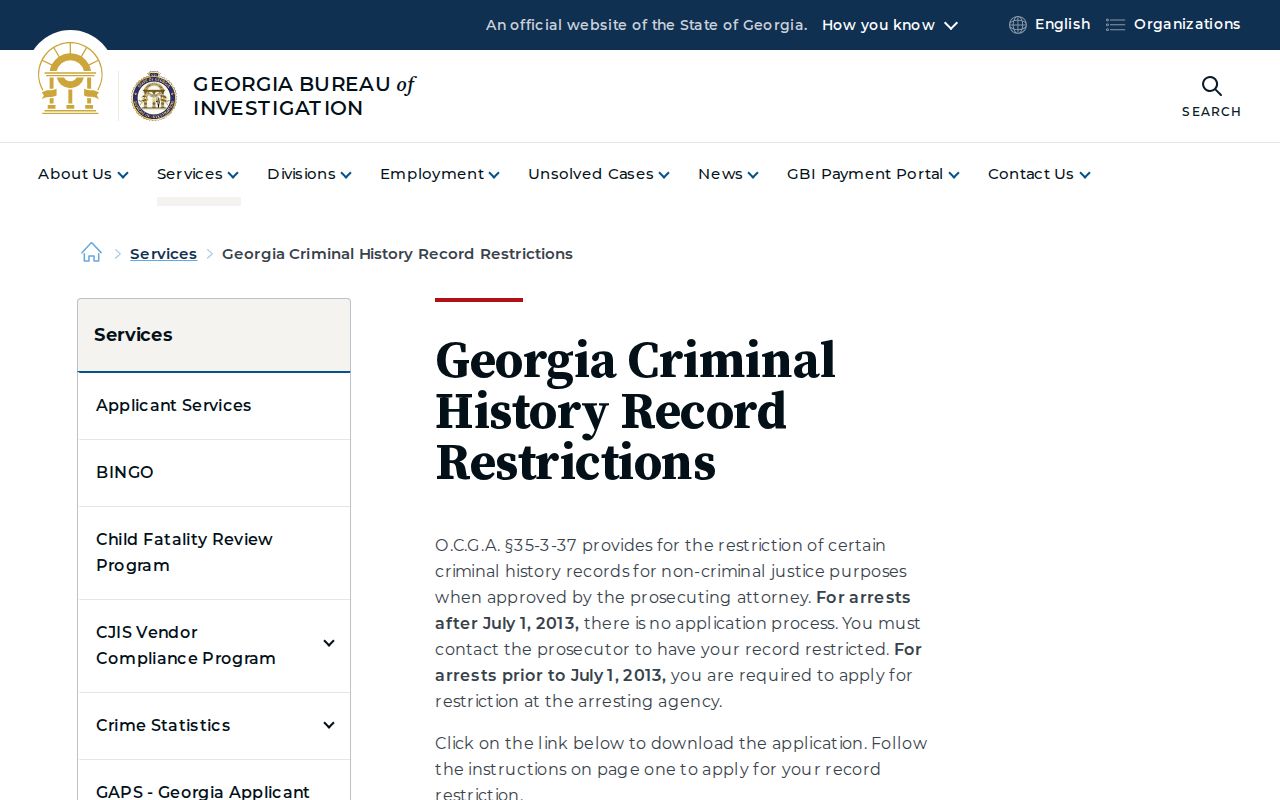
For a missing disposition, first obtain the certified Toombs County court result, then ask the contributing court or agency to correct the source data sent to GCIC.
Keep Toombs Court Notices Current
The Charles Durst release guidance tells felony defendants that court dates are mailed. A released person should update the address with the Clerk of Superior Court. Updating bond or jail contact information is a separate act and does not ensure that the clerk has the right mailing address.
Keep the case number and all court notices. Call the clerk when a date is unclear. Missing mail does not remove the duty to appear. For the custody event that came before the filed prosecution, the county’s arrest history channels explain how the sheriff booking and agency report differ from the court docket.