
How to Check Criminal History in Lyons
Begin with the kind of event, not a broad request for a background check. A police narrative, a city citation, a jail entry, and a felony disposition sit at different counters. Write down the exact name, date, location, report or citation number, and the agency shown on any paper in hand. That short list lets Lyons staff identify the correct file and helps prevent a city matter from being sent to a county clerk too soon.
Use this five-part route for a Lyons record check:
- Call Lyons Police for a city incident or arrest report and ask for the records custodian's written-request method.
- Contact Lyons Municipal Court for a city ordinance or misdemeanor traffic citation, especially when appearance may be mandatory.
- Use the Toombs sheriff roster or records form for a Charles Durst booking created after a Lyons arrest.
- Ask the Toombs clerk for a filed felony, county misdemeanor, docket, or certified disposition.
- Use Georgia Felon Search only when the goal is its statewide felony-conviction product.
The county-wide Toombs County criminal history overview explains the state and county layers in more depth. Lyons requests should stay at city altitude until the source paper points elsewhere.
Three Lyons Criminal Record Counters
Lyons is both an incorporated city and the Toombs County seat. That puts several record offices close together without making them one system. North State Street holds the city police and municipal court counter. Courthouse Square holds the felony and county court file. Northwest Broad Street holds sheriff reports, jail records, and local registry administration. Walking into the nearest office does not give that office control over every record.
The practical test is custody. Lyons Police owns its investigative report. Municipal Court owns its citation docket. The Charles Durst Detention Center owns the booking profile, while Superior or State Court owns the later prosecution. Ask staff which role they are answering in before giving the request details. That one question matters because police and court staff share a street address and telephone number.
Note: A shared Lyons address does not merge police reports, municipal dockets, jail bookings, or county case files into one record.
The Lyons Police Department
The Lyons Police Department is the first custodian for reports created by its officers. Police material can include an incident narrative, the reported place and time, officer actions, property entries, and arrest details. Release may be narrowed when an active investigation, juvenile matter, personal identifier, or victim-safety concern falls within a Georgia Open Records Act exemption.
No dedicated Lyons police-report form, public blotter, base copy fee, or city app was verified in the official research. Call 912-526-3638 during the posted weekday hours and ask for the designated records custodian. Give the event date, location, report number, and a precise description. If staff discusses the request by phone, ask where to send it in writing, how costs will be estimated, and whether electronic delivery is available.
The official police page provides a useful view of the local department. See the source for the Lyons Police image.
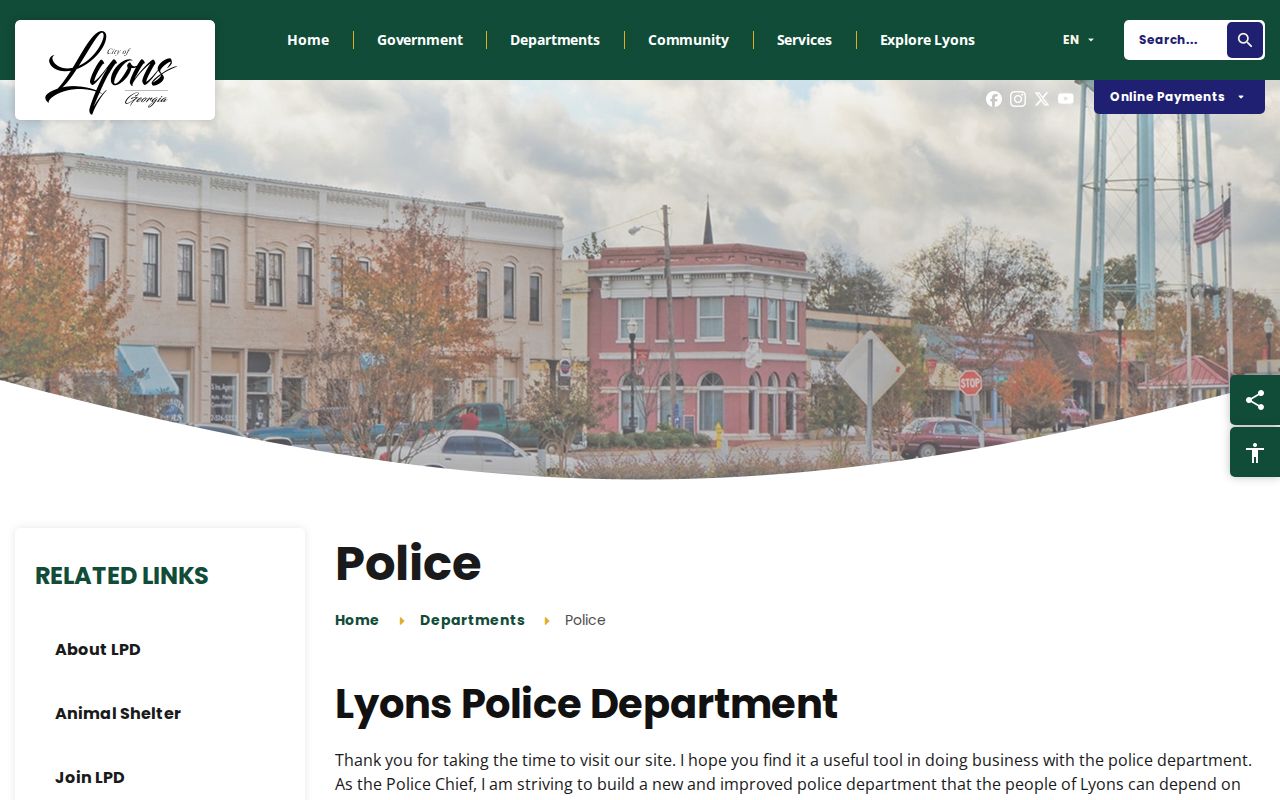
The image reinforces why the city department, rather than a broad county search, is the sound first stop for a Lyons officer's narrative.
Calling the Lyons Records Counter
A focused call saves a second trip. State whether the request concerns Police Records or Municipal Court. For a police file, give the incident date, location, and report number. For a court file, give the citation number, name, and court date. Ask whether identification is needed, what copy or certification cost applies, and how the finished record can be delivered. The published city page lists 912-526-3638, fax 912-526-0901, and Monday through Friday hours of 8:00 a.m. to 4:30 p.m.
If a certified court outcome is needed, use the words “certified disposition.” A payment receipt is not the same document. If no city form is posted, the Georgia Open Records Act still permits a clear written request to the proper city custodian. Do not ask for “everything.” Name the record, date range, and likely city department so staff can estimate scope and cost.
Arrests and Bookings in Lyons
Lyons Police arrestees are booked at the Charles Durst Detention Center, not in a verified city jail. The city report explains why an officer acted. The county booking entry records intake, listed charges, bond, and custody or release status. Those records may be made close in time, yet neither proves guilt. Charges can change after a prosecutor reviews the event.
For current custody, use the sheriff's inmate search. If the person is no longer listed, request the older booking material from the sheriff and supply the booking date. Detention administration can be reached at 912-526-1002 extension 24, with the sheriff main line at 912-526-6778. The originating Lyons police narrative still stays with the city.
A filed charge and final result belong in the court file. Felonies move to Superior Court at the Toombs County Courthouse. State Court handles county misdemeanors, while a qualifying city citation can remain municipal. The detailed Toombs County arrest history route follows a booking through those later stages.
From Lyons Arrest to County Jail
The short physical distance can hide a clear legal handoff. Lyons Police creates its report and transports an arrestee to Charles Durst. Jail staff then make a separate custody entry. A prosecutor decides what accusation or indictment to pursue, and the correct clerk opens a case file. GCIC receives qualifying arrest and disposition data from the agencies responsible for those stages.
Lyons record path: Lyons Police › Charles Durst Detention Center › Toombs County Courts › Georgia Bureau of Investigation and GCIC.
Searchers should compare dates and tracking details rather than assume identical wording. An arrest charge is the officer's intake-stage allegation. A filed charge is the prosecutor's court charge. A disposition is the court's outcome. If an old state history lacks the result, obtain the certified disposition and ask the court or submitting agency to correct the source report.
Note: A current jail search answers custody, while a clerk-certified disposition answers how the prosecution ended.
Lyons Municipal Court Records
Lyons Municipal Court handles misdemeanor traffic offenses and city ordinance violations that occur within city limits. Some citations may be paid without an appearance. Others require the person to appear, so the court directs callers to confirm the citation's status. The office shares 257 N. State Street with Lyons Police and uses 912-526-3638.
| Court Name | Lyons Municipal Court |
|---|---|
| Case Types Heard | Misdemeanor traffic offenses and city ordinance violations within Lyons |
| Case Lookup Channel | Municipal court counter or phone; official payment portal for eligible payable citations |
| What the Docket Shows | Citation, court settings, appearance or payment status, and municipal outcome held by the court |
| Copies & Fees | Ask the court for current plain-copy and certified-disposition charges; no verified schedule was published |
The court page is also an image source for the local jurisdiction statement. View the official Lyons court source.
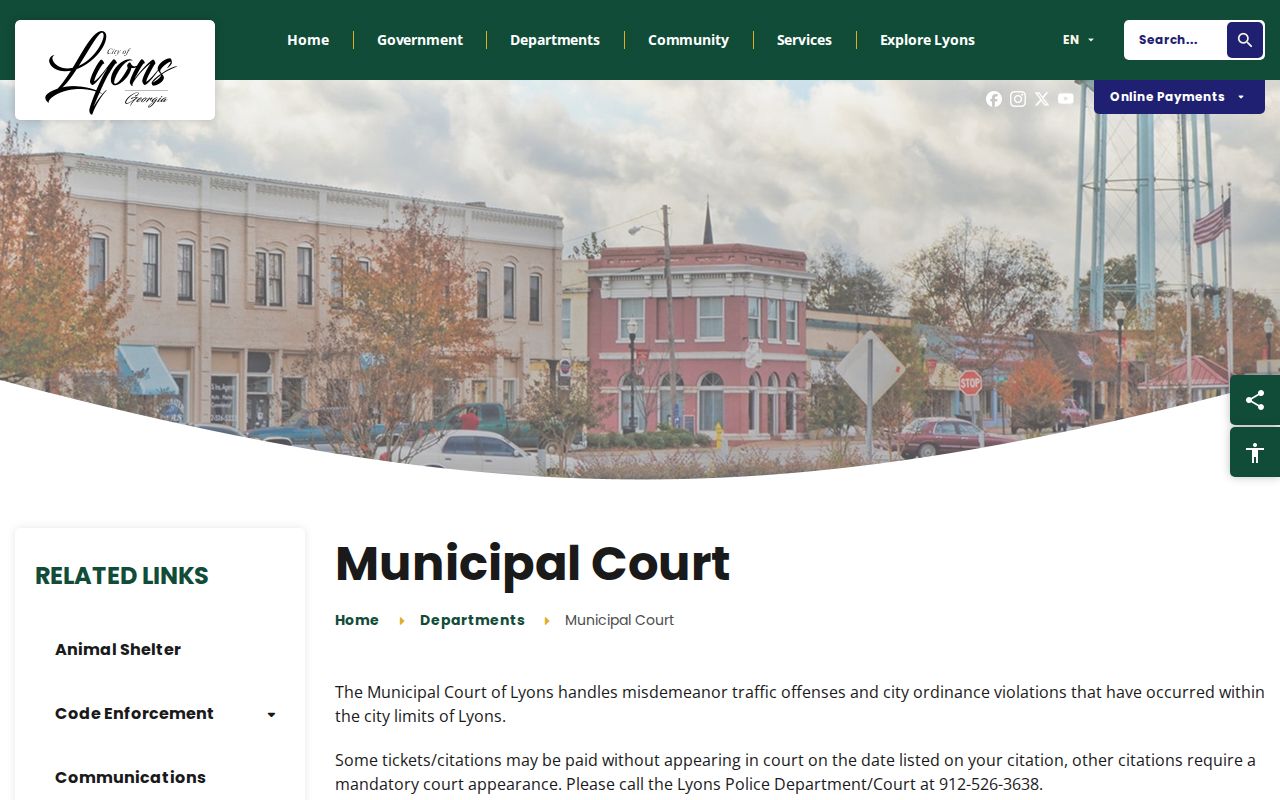
Its narrow list of case types helps separate a Lyons city citation from a felony or county misdemeanor file.
Using the Lyons Citation Portal
The Lyons Municipal Online Payments portal is an official convenience interface for eligible matters. Treat it as a citation lookup and payment tool, not a complete criminal-history database. A match may lead to a payment action and receipt. Keep that receipt and confirm that the court posted the transaction.
A failed search does not prove that no citation exists. The matter may require appearance, be too new for the vendor, use a different spelling or citation number, have closed, transferred, or fall outside municipal jurisdiction. Call the court before drawing a conclusion. Payment also does not, by itself, confirm that a bench warrant was recalled or that every docket entry is complete.
The vendor screen shows the limited role of the online tool. See the source for the Lyons citation portal image.
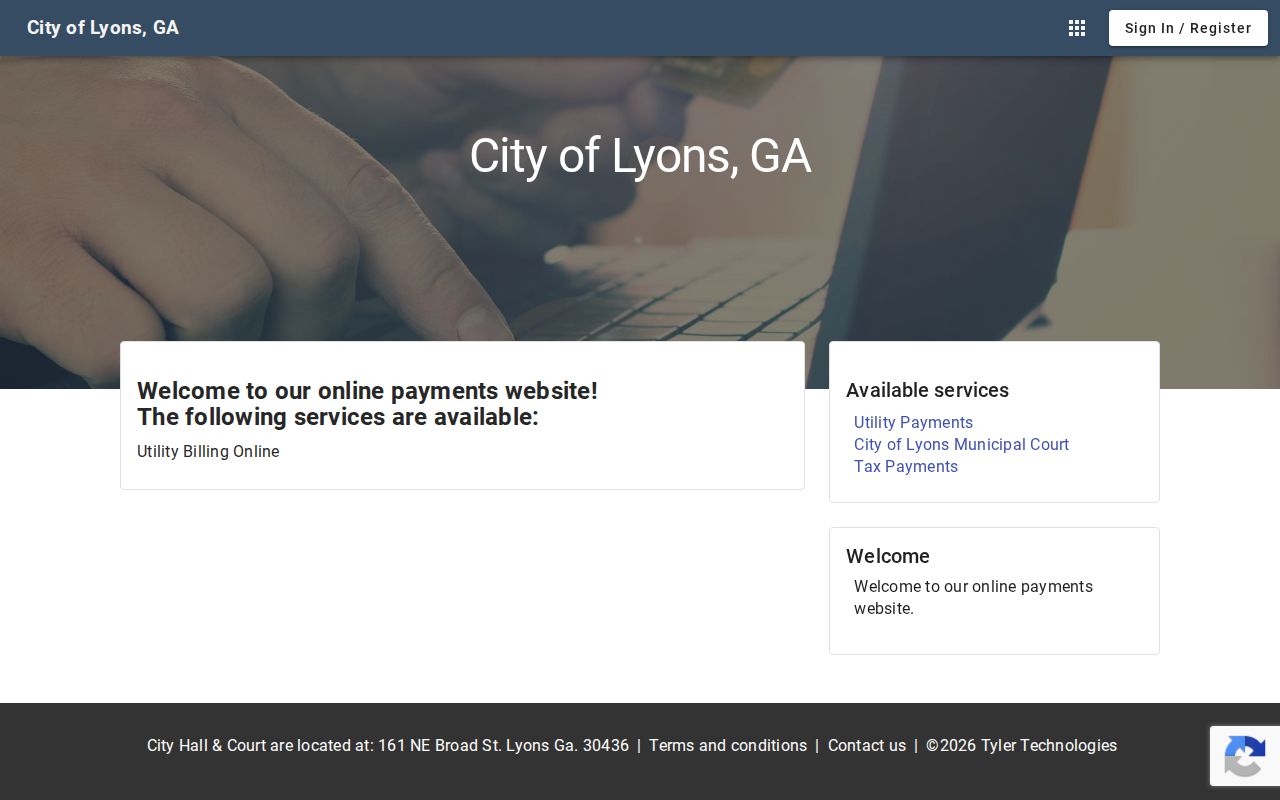
The portal can speed up an eligible payment, while the municipal clerk remains the source for appearance rules and a certified case result.
Where Lyons Criminal Records End Up
Recent city activity begins with Lyons Police or Municipal Court. County custody appears with the sheriff. Serious filed charges move to the Toombs clerk, and qualifying identity-based information is later sent to GCIC. Because each source answers a different question, a sound search follows the path of the event instead of relying on one name query.
Record flow: Lyons Police › Toombs County Courts › Georgia Bureau of Investigation, Georgia Crime Information Center.
Georgia Felon Search can return its statutory statewide felony-conviction product using full name, race, sex, and date of birth. It does not replace a Lyons report, municipal docket, county booking, misdemeanor file, or restricted record. For one's own more complete identity-based history, use an authorized local or fingerprint-supported inspection channel.
Lyons City File or County Case
The paper in hand usually resolves the venue. A Lyons ordinance citation or qualifying traffic case points to Municipal Court. A jail bond sheet points first to Charles Durst for custody facts. An accusation, indictment, or felony court notice points to the Toombs clerk. The arrest location alone does not decide which agency made the stop or which court later received the case.
- Citation
- The officer-issued document naming the alleged violation, issuing agency, and court.
- Accusation
- A prosecutor's formal charging document, often used for misdemeanor or some felony cases.
- Indictment
- A grand jury's formal felony charging instrument.
- Disposition
- The court's recorded outcome for a charge, such as conviction, dismissal, or acquittal.
Ask for the record that proves the point at issue. A police report supports the incident account. A docket shows case events. A certified disposition shows the final result. The portal receipt proves a payment transaction, not the full course of a case.
Public Access Rules for Lyons Records
Georgia law starts with access but preserves specific exemptions. Send a request to the agency that keeps the record. Lyons Police cannot certify the county court's result, and the Toombs clerk does not own the city's investigative narrative. Ask for an estimate when copies, redaction, search time, or certification may add cost.
Key Statutes:
Georgia Open Records Act, O.C.G.A. §50-18-70 et seq. presumes access to agency records subject to exemptions and a three-business-day response framework.
O.C.G.A. §35-3-34 governs GCIC dissemination and permits a defined public felony-conviction search with identifying inputs.
O.C.G.A. §35-3-37 sets Georgia's record-restriction process and preserves authorized criminal-justice access.
Restricted, sealed, juvenile, victim-sensitive, security-related, active-investigation, and personal identifying material may not be open. A timely response can give an availability date and cost estimate rather than every responsive page at once.
If a Lyons Record Is Missing
First confirm the custodian. Ask Lyons Police about the incident, Municipal Court about its citation docket, the sheriff about booking, and the county clerk about a filed case. Check the spelling, date, citation or case number, and whether the matter was transferred. A portal miss should lead to a clerk call, not an unofficial people-search service.
If one's own GCIC record lacks a disposition, obtain the court's certified result and identify the arrest cycle, OTN, SID, or arrest date when available. GBI directs the person to the court or contributing agency because GCIC does not invent a missing result. The source office must transmit the correction.
For a written city request, state a narrow date range and record type. If Lyons does not hold it, ask whether staff can identify the correct custodian. That preserves a clean request trail and avoids treating the county seat as one unified records desk.